Display Ad Strategies for Alaska Businesses
August 4, 2026



Display ads are the visual ads you see while reading the news, checking the weather, watching videos, using mobile apps, or browsing other websites. They can include static graphics, animated banners, and short videos designed to build awareness, promote an offer, or bring potential customers back to a website.
The basic idea is the same everywhere, but successful display advertising in Alaska requires a more thoughtful approach. Our population is spread across a large area, customer demand can change quickly with the seasons, and a strategy that works in Anchorage may not make sense in Fairbanks, Juneau, or the Mat-Su Valley.
For Alaska businesses, the most important questions are not simply where an ad can run. The real questions are: Who needs to see it? Where do they live, or where are they planning to travel? When are they most likely to make a decision? And how far can your business realistically serve them?
Answering those questions before a campaign launches can help reduce wasted impressions and make the advertising budget work harder.
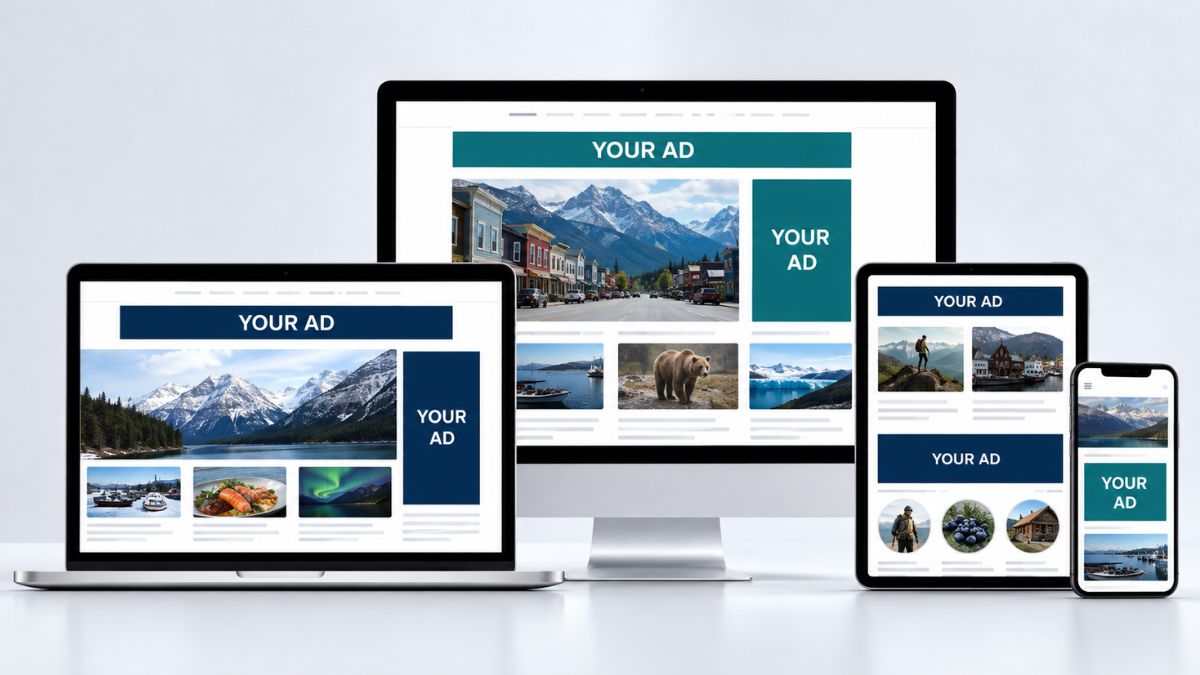
There is no single placement that works best for every Alaska business. The right mix depends on what you are promoting and how your customers make decisions.
Alaska travel planning often begins months before a visitor arrives. Lodges, charter companies, tour operators, and other tourism businesses should start building awareness while potential customers are still researching their trip.
That may mean reaching travelers in key Lower 48 markets during the winter and early spring, then retargeting people who have visited specific lodging, tour, or booking pages. Visual ads and video can be especially effective for tourism because Alaska’s scenery and experiences are often the strongest selling points.
Waiting until the summer season is already underway may be too late. By then, many travelers have chosen their destinations, booked accommodations, and finalized their activities.
Plumbers, heating companies, roofers, contractors, restoration companies, medical providers, and other service-based businesses usually do not need to reach all of Alaska. They need to reach people within the communities they can actually serve.
A tightly focused campaign can target areas such as Anchorage, Eagle River, the Mat-Su Valley, Fairbanks, or Juneau rather than paying for impressions across the entire state. Targeting should reflect real service boundaries, not just a large radius drawn around a business address.
Timing also matters. Heating and plumbing needs may increase during a cold snap, while roofing, construction, and outdoor services follow a different seasonal pattern. Updating the campaign schedule and creative to match current conditions can make the advertising more relevant.
For retailers, display advertising works well when it supports a clear offer with a defined end date. A focused campaign before and during a sale can build awareness and encourage store visits while the promotion is still active.
Ads should run close to the communities where customers shop, feature simple messaging, and make the offer easy to understand at a glance. Creative should also be updated promptly so customers are not seeing an expired promotion.
Out-of-Home (OOH) digital screens placed in restaurants, gyms, salons, medical offices, and other high-traffic locations can add another layer of local visibility. Unlike online ads, these placements do not rely on someone clicking. Their value comes from repeated exposure while people are already spending time in a local business.
Elevate Digital Marketing Solutions offers an Anchorage-area Digital Billboard Network with screens placed in local venues. These placements can work alongside programmatic display ads, social media, sponsored content, and other advertising to create a more consistent presence across the community.
Because digital screens and online ads are measured differently, they should not be judged by the same metrics. Online campaigns can track clicks, website activity, calls, and form submissions. In-location screens are better evaluated through reach, frequency, promotional lift, branded search activity, and other signs of increased awareness.
Programmatic advertising uses automated technology to purchase ad placements across a large network of websites, apps, and digital platforms. It gives advertisers more control over audience targeting, geography, timing, frequency, and campaign optimization than a basic direct display purchase.
This can be useful in Alaska, but more targeting is not automatically better. Small audiences can become too narrow, making campaigns more expensive and repeatedly showing ads to the same people. A strong media plan balances precision with enough reach to deliver meaningful results.
Anchorage often has enough audience volume for tighter geographic targeting and frequency controls. Statewide campaigns usually need broader regional groupings because Alaska’s communities are smaller and widely separated. A statewide message may also need different creative for Southcentral, the Interior, Southeast, and rural communities rather than treating the entire state as one audience.
Advertising platforms offer different combinations of inventory, audience data, and geographic targeting. However, most businesses do not need to choose a platform first. The better starting point is the campaign goal, target audience, service area, and budget. The technology should support the strategy - not determine it.
There is no single reliable CPM or monthly price that applies to every Alaska display campaign. Costs vary based on the audience, geography, placement quality, season, campaign length, and level of competition.
Geography and audience size. An Anchorage-only campaign will generally have more available impressions than a campaign targeting several smaller communities. Very narrow targeting can increase costs and limit delivery.
Placement quality. Premium news sites, streaming video, and connected TV typically cost more than broad website and app inventory. Lower-cost impressions may increase reach, but they are not always the placements most likely to hold someone’s attention.
Seasonality. Tourism, retail, home services, and outdoor industries each have periods when customer demand and advertising competition increase. Planning early gives businesses more flexibility with timing and budget.
Campaign length. A short promotional push may make sense for a specific sale, but it gives the campaign less time to gather data and optimize. Longer campaigns generally offer more opportunities to learn which audiences, placements, and creative perform best.
Creative and campaign management. Budgets should account for ad design, resizing, updates, tracking, optimization, and reporting, not only the cost of buying impressions.
Before approving a proposal, ask for a media plan that explains the target areas, estimated impressions, placement types, campaign dates, and how results will be measured. A low CPM may look appealing, but inexpensive impressions do not provide much value if they reach the wrong audience.
In Alaska, advertising decisions are closely tied to geography, weather, travel patterns, and seasonal routines. Breakup, fishing season, cruise arrivals, construction season, school schedules, and PFD season can all affect when people shop and what services they need.
A local team understands that Anchorage and the Mat-Su Valley are connected markets, but they are not interchangeable. It also understands that reaching Fairbanks, Juneau, Utqiaġvik, and other rural communities may require different messaging and media choices.
That local knowledge can help define realistic service areas, choose better campaign timing, and avoid spending money in locations a business cannot serve. It also makes it easier to respond quickly when an offer, event, or weather-related need changes.
Self-service advertising platforms can be a good fit for businesses with an experienced in-house media buyer and the time to monitor campaigns closely. Working with an agency may be the better option when strategy, creative production, targeting, optimization, and reporting all need to be managed together.
Impressions and clicks are helpful, but they do not tell the whole story. The right measurement depends on the campaign goal.
For an awareness campaign, look at reach, frequency, video completion rates, website engagement, and increases in branded search activity. For lead generation, track phone calls, form submissions, booked appointments, and cost per qualified lead. Retail campaigns may also consider store traffic, offer redemptions, online sales, or sales activity during the promotional period.
Lead quality should be reviewed by location. A campaign may generate inquiries that look good in a report but come from communities outside the business’s service area. Tracking where leads come from helps reveal whether the targeting is supporting real business opportunities.
Display ads include banners, static graphics, animated ads, and video placements that appear across websites, apps, streaming content, and other digital environments. They are commonly used to build awareness, promote an offer, or reconnect with people who previously visited a website.
Many travelers research and book Alaska trips several months in advance. Tourism campaigns often benefit from starting during the winter or early spring, depending on the audience and booking window. Retargeting can then help keep the business visible as travelers compare options and finalize their plans.
Usually not. A service business should focus on the communities it can realistically reach. Tighter geographic targeting can reduce wasted impressions, but the audience still needs to be large enough for the campaign to deliver effectively.
Programmatic display is useful when a campaign needs flexible audience targeting, multiple geographic areas, retargeting, frequency controls, or access to a broad range of online inventory. A direct placement may be a better fit when a specific Alaska publisher, website, or venue already reaches the exact audience you want.
They can, but display advertising is often strongest as an awareness and consideration tool. People may see an ad several times before searching for the business, visiting the website, or making contact. That is why display campaigns should be evaluated alongside website traffic, calls, conversions, branded searches, and other marketing activity.
Not necessarily. Businesses with an experienced in-house team may be comfortable managing campaigns directly. An agency can be helpful when you need support with planning, audience targeting, creative production, optimization, reporting, and coordinating display ads with other marketing channels.
Effective display advertising is not about reaching the largest possible audience. It is about reaching the right people, in the right places, when they are most likely to pay attention.
For Alaska businesses, that means building the campaign around real service areas, seasonal demand, customer travel patterns, and measurable business goals. With a clear plan and consistent optimization, display ads can strengthen brand awareness, support promotions, and help more potential customers discover your business.
Ready to plan your next campaign? Talk with Elevate Digital Marketing Solutions about display advertising designed for Alaska businesses.